Two things catch group organizers off guard at Portland International Airport: the upper roadway is for departures and the lower roadway is for arrivals — and they are not interchangeable. Drop your group at the wrong curb and they are hauling checked bags across a busy multilevel roadway on the first morning of their trip, trying to figure out where the terminal doors actually are. PDX has spent the better part of a $2.15 billion expansion adding floor space, concourses, and a nine-acre mass-timber roof to the main terminal — but the two-roadway setup is unchanged, and it is still the detail most first-time group organizers miss.
One well-timed bus run solves it entirely. Your group loads at a single pickup point anywhere in the Portland metro, rides together, and gets deposited at the right curb on the right level with enough buffer left for checked bags and security. Here is exactly how that works — the commercial curb, the staging lot, the drive times from downtown and from the westside, and the honest buffer numbers for a group of 20 or more.
Portlandpartybuscompany.com connects you to a large network of bus companies serving Portland, and getting a quote for your specific date, group size, and pickup location takes under 30 seconds online or with one call to 971-360-9450. No account required, no obligation. The Portland airport transportation page has an overview of vehicle types and service areas for airport runs across the metro.
Why Rent a Bus to Portland International Airport for Your Group?
Airport Way is the busiest surface street in Oregon — roughly 60,000 vehicles per day on an ordinary weekday — and it is the only approach road into PDX from any direction. There is no alternate route that bypasses it. During morning rush (7–9 AM) and the afternoon window (3:30–6:30 PM), that single corridor backs up from the terminal curb all the way to the I-205 interchange, adding 20–30 minutes to any drive that would otherwise take 10.
A group of 20 people who each drove separately to the airport is a group that needs 20 separate parking spots in the garage, 20 individual commutes through that bottleneck, and — on the return — 20 separate rideshare pickups from the lower curb where Uber and Lyft queue up fast after a busy arrival wave.
One charter bus or minibus changes all of it. Your group loads at a single point, rides together, and arrives at the right curb — upper for departures, lower for arrivals — without anyone navigating Airport Way solo at 5 AM or hunting for a long-term garage spot before a week-long trip. On the return, the bus is staged off NE 82nd Avenue and pulls to the lower roadway the moment your coordinator confirms the group has bags and is ready.
No surge pricing, no six-car caravan regrouping, no garage receipts to reconcile later.
Charter Bus and Party Bus Drop-Off at Portland Airport PDX — The Upper Roadway
When your group is departing — catching flights out of PDX, not collecting anyone — the correct curb is the upper roadway. PDX runs a two-level curbside setup: the upper roadway is the Departures level, where arriving vehicles drop off passengers heading into the terminal. Commercial vehicles, including charter buses, party buses, and scheduled shuttles, use the outermost lane on the upper roadway, clearly marked "Commercial Vehicles."
Per PDX's published ground transportation guidance, that commercial lane sits approximately 50 feet from the terminal doors — a direct walk to the check-in lobby without crossing another travel lane.
The practical sequence: your bus follows I-84 East to I-205 North, takes the Airport Way exit, and approaches the upper-level roadway following departures signage. The bus pulls into the commercial vehicle lane on the outer curb, your group unloads and moves toward the terminal, and the bus exits. Only active loading and unloading is permitted at the curb — commercial motorcoaches do not linger or wait there once the group has cleared.
The inner lanes on the upper roadway are for private passenger vehicles; the outermost lane is where a charter bus belongs. Get the level wrong — pull to the lower roadway for a departure drop-off — and your group is at arrivals, one floor down, on the wrong side of the terminal from ticketing and check-in.
Upper roadway = Departures. Lower roadway = Arrivals. Commercial vehicles use the outermost lane on the upper level, roughly 50 feet from the terminal doors.
Private cars use the inner lanes on the same level. This is the one logistical fact worth drilling into every group coordinator before the morning of departure — the two roadways are not adjacent, and they are not signed in a way that corrects a mistake quickly.
Charter Bus and Party Bus Pickup at PDX — The Lower Roadway and the Staging Lot
Arrivals run on a different level entirely. When your group's flight lands and bags are coming off the carousel, the collection point is the lower roadway — the Arrivals level, outside baggage claim. Per PDX's official ground transportation page, shuttles and charter buses picking up arriving passengers use the lower roadway.
The MAX Red Line station is also on this level, adjacent to baggage claim. The rideshare staging area — where Uber and Lyft passengers go — is in the garage structure at the lower level, in designated zones separate from the shuttle and charter bus pickup curb.
Here is the operational detail that surprises most groups: commercial motorcoaches cannot simply park at the lower-roadway curb and wait 30 or 45 minutes for your group to clear baggage claim. Portland airport practice requires commercial vehicles to actively load and move — buses that arrive before the group is ready run up against strict idling limits at the terminal curb. Instead, charter buses stage at the commercial vehicle lot near NE 82nd Avenue and NE Air Cargo Road, roughly 3 minutes from the terminal.
The bus holds there until your group coordinator calls to confirm that everyone has their bags and is standing at the lower-roadway pickup point. Then the bus pulls forward, loads the group, and exits. The cell phone waiting lot — free, 30-minute maximum, at 7722–8168 NE Air Cargo Rd — is in the same area and follows the same logic for personal vehicles.
Gather first, call second. Do not call for the bus while half your group is still watching the carousel. Wait until every person in your group is outside on the lower roadway with all bags in hand.
Then make one call, the bus pulls from NE 82nd Avenue, and loading is fast because everyone is already there. Calling too early means the bus arrives at the curb before the group is ready — a fixable problem, but one that adds time and pressure for no reason.
For groups arriving on multiple flights — half the team lands at 2:15 PM and the rest at 3:40 — the cleanest move is to wait until the last flight is down and every person has bags before calling the bus forward. One pickup, one departure. Coordinating two separate lower-roadway pickups on the same trip doubles the curb exposure and requires tighter timing than most groups expect.
Mention the multiple-flight situation when you request your quote so the staging plan can be built around it from the start.
Inside the New PDX Terminal — What Every Group Should Know After August 2024
Portland International Airport's main terminal expansion — the centerpiece of the $2.15 billion PDXNext program — opened on August 14, 2024, making it the largest public infrastructure project completed in Oregon's history. If your group has not been through PDX since before that date, the terminal will feel substantially different and larger than what they remember.
The most visible change is the nine-acre mass-timber roof — a continuous Douglas fir canopy spanning the entire terminal core, lit by skylights throughout. The terminal now connects directly to four concourses: Concourse B and Concourse C in the south wing, and Concourse D and Concourse E in the north wing. The original Concourse A was demolished during construction; Concourse B was rebuilt and expanded with six additional gates in its place.
The central hallway connector between the south and north wings — the shortcut many regular PDX travelers relied on before construction closed it — reopened in August 2024. Phase 2 of the buildout, covering additional concourse exits, retail expansion, and art installations, continues through early 2026, so some areas may still carry construction signage during your group's visit.
What this means practically for a group planner: the terminal is genuinely bigger, and the walking distances from the TSA checkpoint to gates in Concourse B or Concourse E are longer than pre-expansion distances. PDX's own travel tips page notes that if you have not been through since August 2024, you should plan extra time to navigate the updated terminal. For a group of 20 that is moving at the pace of its slowest member, that is not a throwaway note — budget an extra 10–15 minutes compared to pre-expansion timing assumptions, especially if any member of your group has mobility considerations.
The current terminal layout is on the official PDX airport map at flypdx.com.
Realistic Drive Times from Portland and the Westside Suburbs to PDX
PDX sits northeast of the city, roughly 12 miles from downtown Portland — but the effective drive time from anywhere in the metro depends heavily on the time of day and on which direction you are coming from. The airport's own directions page at flypdx.com says to plan 30–45 minutes from downtown Portland to PDX. That is the right range to use as a baseline, with the adjustments below for different origins and traffic windows:
| From… | Off-peak drive time | Peak-hour drive time | Primary route |
|---|---|---|---|
| Downtown Portland / Pearl District | 25–35 min | 40–55 min | I-84 East → I-205 North → Airport Way West |
| Beaverton (US-26 corridor) | 30–45 min | 40–60 min | US-26 East → I-84 East → I-205 North → Airport Way West |
| Hillsboro | 40–55 min | 55–75 min | US-26 East → I-84 East → I-205 North → Airport Way West |
| Lake Oswego / Tualatin | 35–45 min | 50–65 min | I-5 North → I-84 East → I-205 North → Airport Way West |
| Vancouver, WA | 25–35 min | 35–55 min | I-5 South → I-84 East → I-205 North → Airport Way West |
| Gresham / East Portland | 20–30 min | 30–45 min | I-84 West → I-205 North → Airport Way West |
The critical choke point — regardless of your origin — is the I-84/I-205 interchange, where traffic from both interstates merges toward the northeast and funnels onto Airport Way. Airport Way carries roughly 60,000 vehicles per day, has no meaningful alternate approach road into the terminal, and backs up during both peak windows in a way that is not apparent until your group is already committed to the route. A backup at that interchange can add 20–30 minutes on top of any estimate above, and there is no shortcut that avoids it.
Groups originating from the Intel campuses in Hillsboro or Nike's Beaverton headquarters — two of the Portland metro's largest corporate travel origins — are far enough out that ride-sharing and carpooling start breaking down once the group tops 10 or 12 people. Different employees have different commute windows, different preferred departure times, and different tolerance for coordinating with strangers in a text thread at 4:45 AM. A Portland corporate charter bus rental collects everyone from a single westside staging point, handles the full US-26/I-84/I-205 corridor in one run, and arrives at the upper roadway as a unit — with the departure buffer still intact.
How Much Time Does a Large Group Need at Portland International Airport?
PDX officially recommends arriving two hours before a domestic departure during the busy early morning window, and three hours before international flights. For a group of 15 or more with checked bags, those figures are the floor. Here is where the time actually goes:
Airline check-in and bag drop. Most airlines close checked bag drop 45–60 minutes before domestic departure, and the check-in desk itself closes before that. A group of 20 people checking bags individually at kiosk stations — each person scanning their own boarding pass, paying any bag fees, tagging their own luggage — can easily run 25–35 minutes through the check-in lobby before the last person in the group has cleared the counter, particularly during the peak morning windows of 5:30–8 AM.
Some carriers offer group check-in arrangements when you book multiple seats together; it is worth calling the airline in advance to ask, because a dedicated group counter lane is meaningfully faster than 20 individual kiosk queues. Either way, build 30–45 minutes for check-in and bag drop above the two-hour baseline for any group of 15 or more.
TSA security. PDX TSA wait times run 10–15 minutes during off-peak hours and 30–45 minutes during peak morning and afternoon windows, based on reported averages at the airport. TSA PreCheck helps individuals who qualify, but a group where half the members have PreCheck and half do not splits between lanes and can scatter the group through security at different speeds.
Budget 30 minutes for security for any group of 15 or more, regardless of PreCheck enrollment, unless you are arriving in a clearly off-peak window.
Gate distance inside the expanded terminal. With four concourses now fully operational after the August 2024 expansion — B, C, D, and E — and the terminal footprint roughly doubled from pre-PDXNext dimensions, the walk from the security checkpoint to a far gate in Concourse B or Concourse E is a real distance. A group moving at the pace of its slowest traveler should add 10–15 minutes for gate transit compared to the pre-expansion layout, and more for any member with mobility considerations.
| Group size and situation | Recommended pre-departure buffer at PDX |
|---|---|
| Under 10 travelers, carry-on only | 90 min (off-peak) — 2 hours (peak) |
| 10–20 travelers, carry-on only | 2 hours (off-peak) — 2.5 hours (peak) |
| 10–20 travelers, checked bags | 2.5 hours (off-peak) — 3 hours (peak) |
| 20+ travelers, checked bags | 2.5–3 hours (off-peak) — 3–3.5 hours (peak) |
| Any group, international departure | 3 hours minimum — 3.5 hours for large groups with bags |
The advantage of a coordinated bus pickup is that it removes the most unpredictable variable — the drive — from the morning of departure. The pickup time is set in advance, the route is handled, and the group arrives at the upper roadway as a unit with the full buffer intact. That's meaningfully different from three people showing up 25 minutes early and two more rushing in right as bag drop closes.
Review PDX's current arrival guidance and TSA wait times on the official PDX travel tips page before your group's departure day.
What Parking Costs at PDX — and What a Charter Bus Rental Saves You
PDX parking is tiered by proximity to the terminal, with current rates on the official PDX parking page:
- Short-Term Garage (closest, connected to terminal by skybridge): $4/hour, $30/day
- Long-Term Garage (North and South tunnel connections to terminal): $4/hour, $24/day
- Economy Lot (free shuttle every 7–9 minutes, 4 AM–midnight): $4/hour, $15/day — 7th day free
- Valet Parking (always open, no waiting for a spot): $10/hour, $45/day
Run through the math on a realistic westside group trip. A 12-person team from Hillsboro flying to a conference for four nights drives in 7 separate cars — typical when people are coming from Aloha, North Plains, and different corners of the westside. Seven cars in the long-term garage for four days: $672 before anyone accounts for gas or the 5:15 AM commute on US-26.
Seven cars in the economy lot: $420, but then add the shuttle wait with bags, and the economy shuttle stops at midnight — anyone on a late return either pays the garage rate for that last night or scrambles for alternatives.
To give you an idea of how that compares to renting a bus: a Portland minibus rental for the same 12-person group runs roughly $200–$250 per hour on weekdays through the network. A round-trip airport run — pickup from one Beaverton or Hillsboro staging point, drop at the upper roadway, and pickup from the lower roadway on return day — might run 4–5 hours total for the round trip, putting the all-in range around $800–$1,250. At 12 passengers, that's roughly $67–$104 per person round trip, compared to the $35–$56 per person each person is already paying just to park their individual car.
For groups larger than 12, the per-person math moves further toward the bus — and nobody has to navigate the Airport Way merge before sunrise. Check the Portland party bus prices page for current planning ranges across vehicle sizes.
What Size Bus or Party Bus Rental Does Your Group Need for a PDX Airport Run?
PDX airport trips run the full range of vehicle sizes depending on headcount and luggage volume. The most important spec for an airport run is luggage capacity — a group of 20 people each with a carry-on and a checked suitcase has more physical baggage than most people picture until they are standing at the curb. Here is how the vehicle options from the full vehicle lineup match up to the most common airport scenarios:
| Vehicle | Seats | Luggage capacity | Best for | Key amenities |
|---|---|---|---|---|
| Sprinter Van | Up to 14 | Modest — carry-ons plus a few rolling bags | Small executive teams, families, transfers with light luggage | Premium leather, USB charging, tinted windows |
| 14-Passenger Sprinter Limo | Up to 14 | Light — works best for carry-on-only trips | VIP or corporate groups without heavy checked luggage | Premium leather, individual reading lights, USB charging |
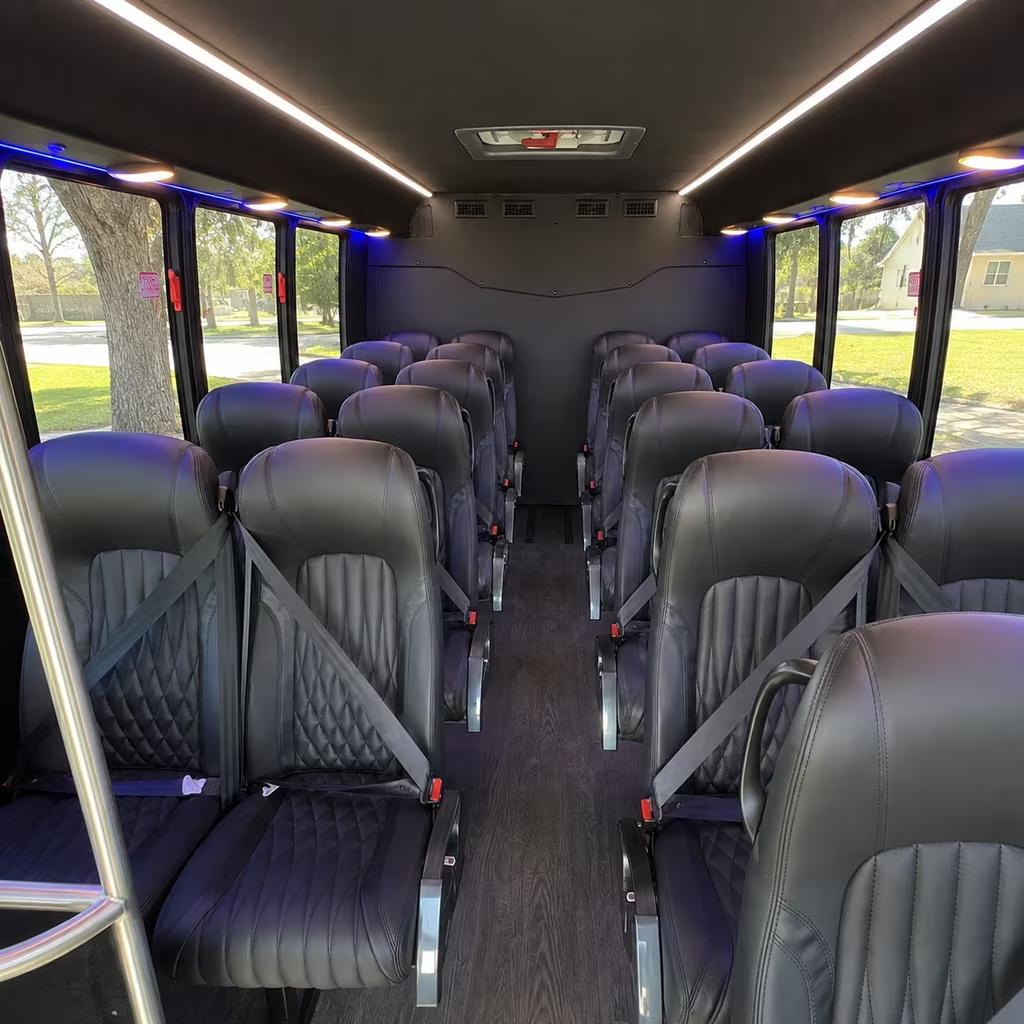
| 15–35 Passenger Minibus | 15–35 | Good — overhead bins plus underfloor storage | Mid-size teams, wedding parties, university groups with a mix of bag types | Climate control, plush reclining seats, overhead bins |
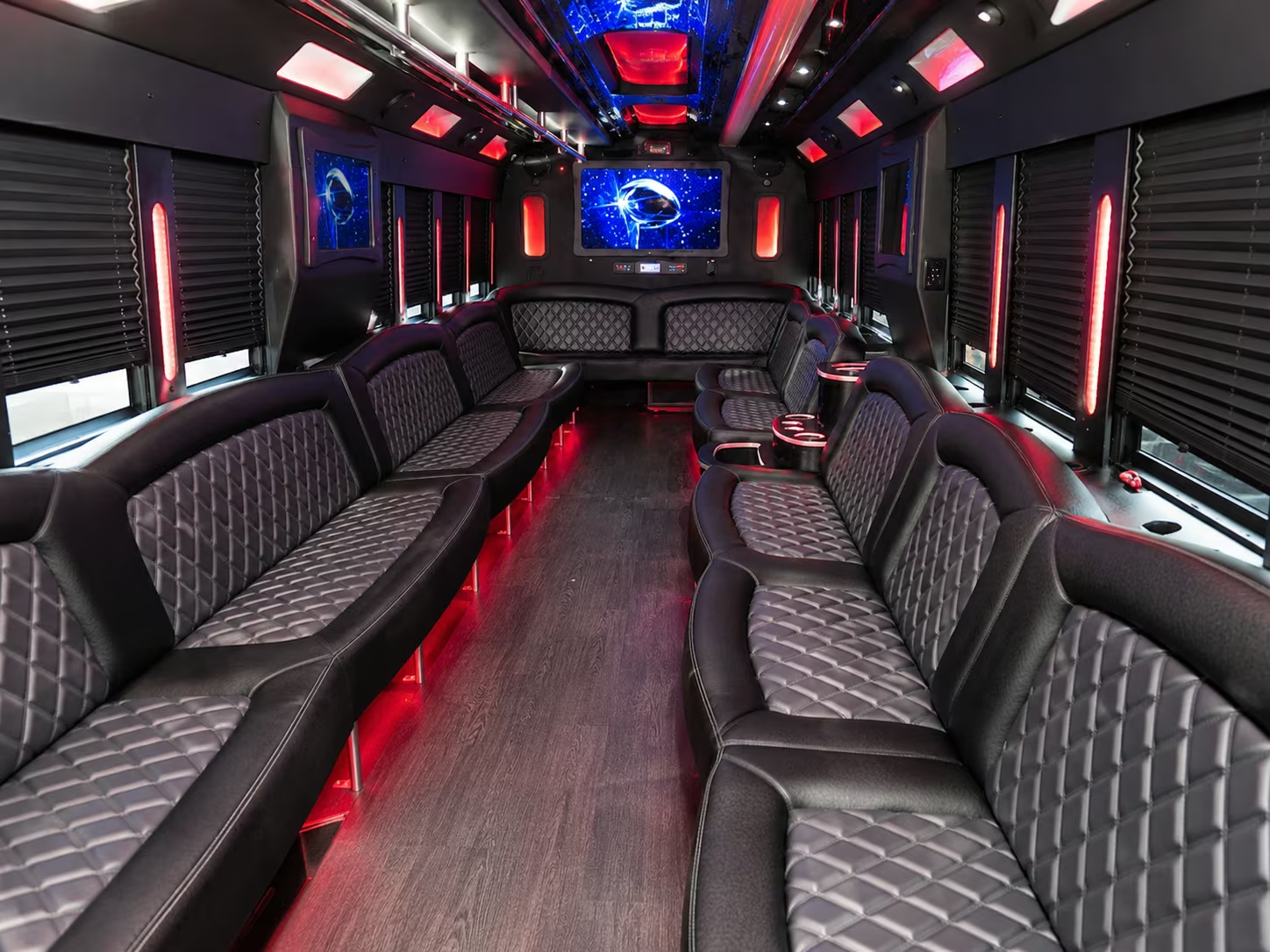
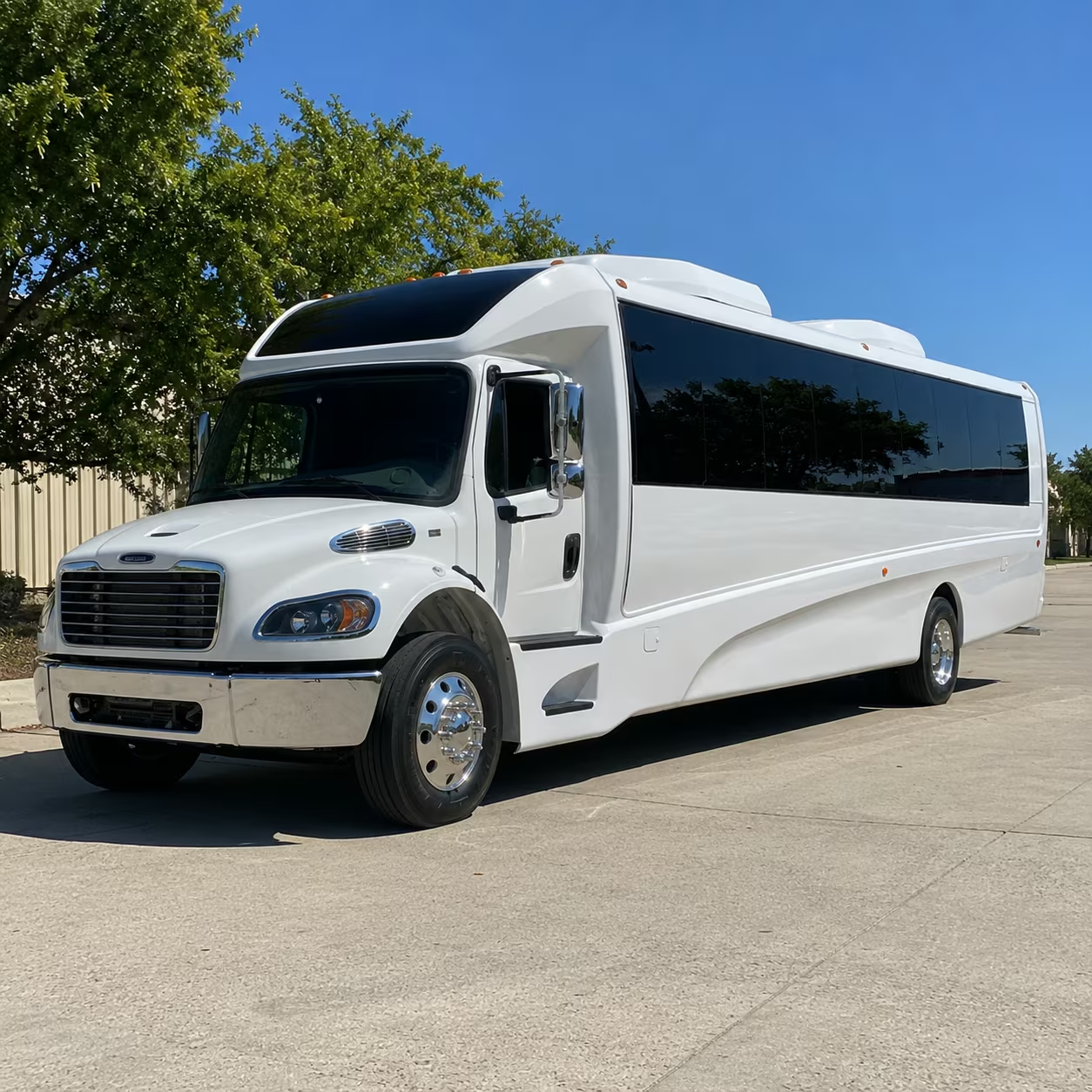
| 40–56 Passenger Charter Bus | Up to 56 | Excellent — deep undercarriage bays for heavy luggage | Large corporate groups, sports teams, conference delegations, multi-family trips | Reclining seats, climate control, WiFi, power outlets, onboard restrooms, undercarriage bays |
For groups where most people are traveling carry-on only, a minibus handles 20 comfortably and is easier to position on the upper roadway commercial lane. When the group has heavy checked bags — a sports team with equipment, a corporate group with presentation materials and rolling cases, a family traveling for a week — the charter bus is the right answer. The undercarriage bays on a 56-seat coach hold rolling suitcases without asking anyone to sacrifice legroom or overhead space inside the cabin.
If anyone in your group has accessibility needs, ADA-accessible vehicles are available through the network — note it when you request a quote.
The MAX Red Line at PDX — When It Makes Sense and When It Doesn't
The MAX Red Line station sits at PDX's lower level adjacent to baggage claim — it is the most convenient transit connection at the airport, and for the right traveler it is genuinely good. The line runs every 15 minutes most of the day and covers the roughly 40-minute trip to downtown Portland for $2.80 per adult, per TriMet's published Red Line schedule. For a solo traveler or a pair heading to the Pearl District or the Lloyd District without heavy bags, the math is hard to argue with.
For a group of 15 or 20 with checked luggage, it does not scale. You are loading rolling bags onto a light rail car that other riders are already using. Everyone needs to tap or purchase a fare individually.
The Red Line terminates in Hillsboro, but the stops through the westside are spread out, and anyone headed to Intel's Ronler Acres campus, a hotel in Beaverton, or an office in Aloha is looking at a MAX ride plus a rideshare or bus transfer leg — the transit routing that works for one person with a backpack adds 75–90 minutes of total travel time for a group with luggage headed anywhere on the westside. That is the gap a charter bus fills directly. Always check TriMet's current schedule for any service alerts before your travel date; the Red Line has had periodic construction-related adjustments through the PDXNext buildout period.
Types of Group Trips That Use a Charter Bus or Party Bus Rental to and from PDX
The coordination benefit of a single bus run to PDX applies regardless of why the group is flying. These are the trips that flow through Portlandpartybuscompany.com's network most often for Portland airport runs:
Corporate team travel from the westside corridors. Intel Hillsboro, Nike Beaverton, adidas, and a growing cluster of tech and biotech companies base significant headcounts in the US-26 corridor. Getting 12 or 15 employees from different westside addresses to PDX's upper roadway by 6 AM — with full luggage — in separate vehicles is a coordination project nobody wants to own.
A single charter bus with one pickup staging point in Beaverton or Hillsboro solves it with a single call. See the Portland corporate transportation page for how these runs typically get structured.
Conference and convention groups at the Oregon Convention Center. Groups flying into PDX for events at the Oregon Convention Center — on NE Martin Luther King Jr. Blvd, about 20 minutes from the airport — use a charter bus to handle the airport-to-venue leg as one coordinated move rather than splitting a 30-person delegation across rideshares and hotel shuttles. Same logic on departure day: one bus from the hotel to the upper roadway, bags checked, group on time.
University and college sports teams. Teams flying out of PDX with equipment bags — sticks, pads, gear duffels — rule out the MAX and fill up multiple rideshares in a way that does not work for anything with a departure deadline. A 40- or 56-seat charter bus with undercarriage bays handles the full equipment load in one vehicle and gets the team to the upper roadway with time to check bags at the counter.
Multi-family vacation groups. Ten adults from five different Portland-area households flying somewhere together — each with their own car at home, their own neighborhood, their own reluctance to drive to the airport before dawn. One charter bus from a single central pickup point removes the coordination problem entirely and keeps parking costs off everyone's individual bill.
See the full Portland group transportation services page for how multi-origin pickups are typically structured.
Wedding and event groups flying in or out together. A bachelorette group catching an early morning flight, or a wedding party picking up out-of-town guests arriving on multiple flights in the same afternoon window. A Portland wedding party bus rental handles the airport leg without anyone driving, and the lower-roadway pickup sequence works for arrivals whether the group lands together or in two waves.
Frequently Asked Questions About Renting a Bus to PDX
Where does a charter bus or party bus drop off at PDX for departures?
Departing passengers are dropped off on the upper roadway — the Departures level at PDX. Commercial vehicles including charter buses and shuttles use the outermost lane on the upper roadway, marked "Commercial Vehicles," approximately 50 feet from the terminal doors. The inner lanes on the upper roadway are for private passenger vehicles.
Do not pull to the lower roadway for a departure drop-off — that level handles arrivals and is a different floor with different access to ticketing and check-in.
Where does a charter bus pick up at PDX after a flight lands?
Arriving passengers are collected from the lower roadway — Level 1, outside baggage claim. Per PDX's ground transportation guidance, shuttles and charter buses picking up arriving passengers use the lower roadway. Because commercial vehicles cannot wait indefinitely at the terminal curb, the bus stages at the commercial vehicle area near NE 82nd Avenue and NE Air Cargo Road and pulls to the lower roadway only once the group coordinator confirms everyone has bags and is standing at the pickup point.
The cell phone waiting lot at 7722–8168 NE Air Cargo Rd is in the same area for personal vehicles following the same protocol.
How do I handle a pickup when our group arrives on multiple flights?
The cleanest approach: wait until the last flight has landed and every person has their bags before calling for the bus. One pickup from the lower roadway is simpler and faster than two separate curb stops. If the flights are more than an hour apart, note it when you request your quote — the staging plan can be built around multiple arrival windows, and the timing is worked out in advance rather than on the fly at the curb.
How much does it cost to rent a bus to or from Portland Airport?
Portland minibus rentals run roughly $200–$250 per hour on weekdays and $200–$275 per hour on weekends through the network. A 40–56 passenger charter bus runs approximately $200–$350 per hour. Total cost depends on group size, pickup location, how many hours the vehicle is needed, and the date.
To give you an idea: a round-trip airport run for a group of 20 on a weekday block of 3–4 hours might land somewhere in the $600–$1,000 range — check the Portland party bus prices page for planning ranges by vehicle type, or call 971-360-9450 for a quote specific to your date and itinerary in under 30 seconds.
How far in advance should I book a charter bus to PDX?
For standard airport runs — corporate travel, family trips, sports teams — two to four weeks of lead time is workable for most dates. For the peak travel windows at PDX (Thanksgiving week, the December holiday stretch, July 4th, and spring break in late March), the right vehicles book out faster than people expect. Booking 6–8 weeks out for peak periods gets you better selection and avoids competing with groups who planned ahead.
For very large groups — 40 or more people, or trips that need multiple buses running simultaneously — call as soon as the travel date is confirmed.
How long should our group buffer before a domestic flight at PDX?
PDX officially recommends two hours before domestic departures during busy early morning windows and three hours before international flights. For groups of 15 or more with checked bags, add 30–45 minutes to those baseline windows for the check-in and bag-drop process. Peak departure windows at PDX are 5:30–8 AM and 3:30–6:30 PM; during those windows, TSA queues can run 30–45 minutes even without a large group slowing the check-in lobby.
The buffer breakdown by group size is in the table above.
What does parking cost at PDX?
Short-term garage: $30/day. Long-term garage: $24/day. Economy lot: $15/day (7th day free), with a free shuttle every 7–9 minutes from 4 AM to midnight.
Valet: $45/day. Current availability, rates, and any discounts are on the official PDX parking page. For groups with five or more cars, the parking cost comparison to a single charter bus often favors the bus — see the worked example in the parking section above.
What changed at PDX after the August 2024 expansion?
The main terminal opened August 14, 2024, as part of the $2.15 billion PDXNext program. The headline change is the nine-acre mass-timber roof spanning the entire terminal core. Concourse A was demolished; Concourse B was rebuilt and expanded with six additional gates.
The four active concourses are now B and C (south wing) and D and E (north wing), with the central connector between the wings reopened in August 2024. Phase 2 — retail buildout and art installations — runs through early 2026. The terminal footprint is roughly double what it was before construction.
Current maps are on the official PDX airport map page.
Can the MAX Red Line take a large group from PDX?
The MAX Red Line station is at PDX's lower level adjacent to baggage claim and runs about 40 minutes to downtown Portland for $2.80 per adult, with 15-minute frequency most of the day. For a small number of travelers without heavy bags headed to the inner city, it is an excellent option. For a group of 15 or more with checked luggage, it is not practical — the luggage volume, individual fares, and the transfer requirements for anyone heading to the westside suburbs make the travel time and coordination cost significantly higher than a single bus run.
Check the TriMet Red Line schedule for current service and any active alerts before your travel date.
Rent a Charter Bus or Party Bus to PDX Today
Whether it is a 10-person executive team heading out of Hillsboro, a 40-person sports squad with a full equipment load, or a multi-family vacation group catching a morning flight with zero interest in Airport Way at 5 AM — Portlandpartybuscompany.com connects you to charter buses, minibuses, and Sprinter vans serving Portland and the surrounding metro. Get pricing online in under 30 seconds or call 971-360-9450 any time — a support team is available every day of the year to match your group size, pickup location, and departure window to the right vehicle. No account required, no obligation.
Also planning a Portland event stop on the same trip? The guide to getting a group to the Oregon Convention Center and the Moda Center bus guide cover their own drop-off specifics — useful if the itinerary includes a conference or game before or after the airport run.